LAV Tübingen
A club site and kit shop that take paperwork off the office
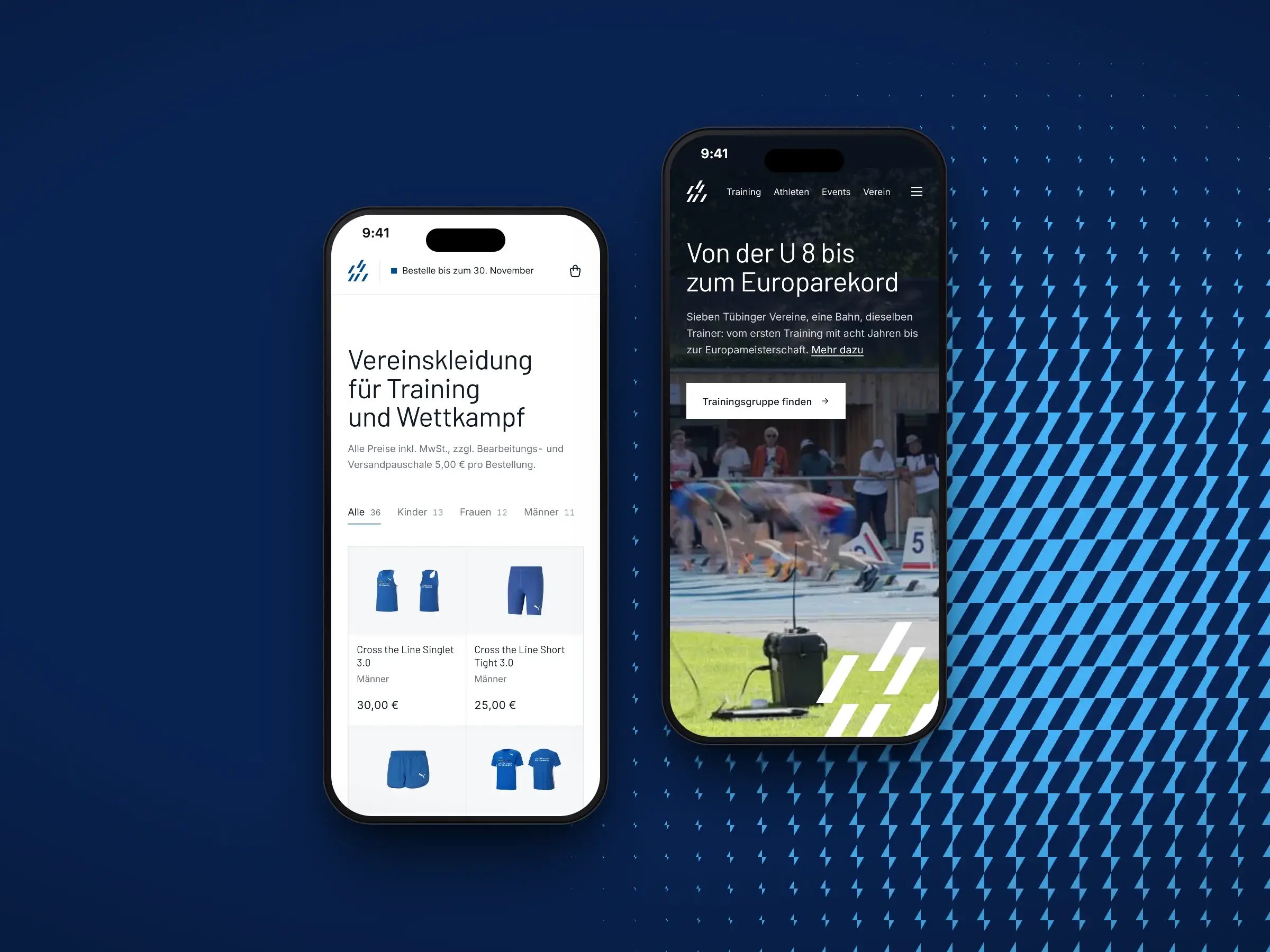
I rebuilt the website of an athletics club and its kit shop around four decisions: membership fully online and straight into the member database, events inside the site, a shop without stock, and a stack that already existed. The first test stage went up two days after the brief was confirmed.
- Role
- Product decisions, design and build (freelance)
- Team
- Solo, with the club office and board
- Timeframe
- Since November 2026
2 days
From confirmed brief to a test stage with all content of the old site
10 days
From shop brief to a working Stripe checkout
100
Lighthouse accessibility score on every page type tested
Context
LAV Tübingen calls itself the most successful athletics club in Germany: seven clubs that compete as one team. Its website and its kit shop had grown apart from how the club actually works. Membership ran on a PDF, the club’s three races each lived on their own WordPress site, and the shop had to be rebuilt.
The club gave the new site four jobs: win new members, keep members informed about events, show what the athletes achieve, and present the training on offer.
The problem
The club has no developer of its own. Whatever I built had to be cheap to run, quick to ship, and simple enough for club staff to keep up to date. At the same time the club’s ambition is national, and the site has to look like it.
Most of the hard part was not design. It was deciding what not to build, and which manual work the site should take over.
Key decisions
Membership became a workflow, not a form The old route was a PDF. I moved the whole process online. An application is stored in the CMS with a status and a reference number, the office and the applicant get an email, minors get a guardian section, and the new member goes straight into Webling, the club’s member database, including the bank details for the direct debit. A new role, “Geschäftsstelle”, sees only the applications and nothing else. Cancelling a membership got its own online form too, because there had been no way to do it on the site at all.
The club’s races moved into the site Österberg 333, Tübingen fast 10K and LAV and Friends each had a separate WordPress site. I made each one a self-contained one-pager inside the club site, with its own section navigation and the race result registration embedded. One login, one design, one place to update.
The shop holds no stock The club sells kit in ordering phases and orders from a dealer only when a phase closes. I designed the shop around exactly that: orders are accepted only while a phase is open (checked on the server, not only in the browser), payment is taken at checkout through Stripe, items the dealer can’t deliver are refunded through Stripe, and at the end of a phase the club downloads one order sheet with quantities per product and size. No customer accounts: anyone can order as a guest.
I reused instead of inventing I had just built the Tübinger Erbe Lauf site on Next.js and Payload CMS, with deploys, backups and the race result embed already solved. Taking the same stack meant the first test stage, with 300 posts and 517 images from the old site, went up two days after the brief was confirmed.
Approach
- Athletes as a top-level page Instead of an abstract “competition” section, the athletes get their own page with records, all-time lists and results. Showing success was one of the club’s goals, and it is what fans and press look for.
- Colour almost absent My first direction, paper and serif type, felt chaotic and generic, and I dropped it. The final design uses the six bars of the club logo, set at 60°, as its only graphic device: in the hero, as photo masks, as a grid. Navy appears on the logo, the primary button and one dark passage per page.
- What not to build For the shop I weighed Shopify (monthly fees, and ordering phases don’t fit its model), Payload’s e-commerce plugin (still in beta, brings accounts nobody needs) and Medusa (a separate commerce server, far too heavy for one catalogue). A small app of its own with Stripe Checkout was the cheapest thing that fits. Vouchers are Stripe promotion codes the club creates itself, so there was no voucher system to build.
- No third parties by default Google reCAPTCHA was replaced by self-hosted bot protection, venues link to a map instead of embedding one. Google Analytics, which the club wanted, loads only after consent.
Outcome
The club site runs on a test stage, the shop takes test payments through Stripe, and both go live on the club’s domains once the club has signed off the legal texts. Lighthouse gives every page type tested an accessibility score of 100.
What changed for the club is less visible: membership applications reach the member database without anyone retyping them, the three races are maintained in the same place as the rest of the site, and the kit shop has no stock risk. Where the old site’s facts contradicted each other, I didn’t quietly pick one. I gave the club a list to decide.
What I’d do differently
I decided once to build the shop into the club site and reversed it the same day. Writing down the consequences before deciding, a separate admin and a design to keep in step by hand, would have made it a five-minute question.